
Atoka County Arrest Records and Court Charges
An Atoka County arrest record begins the moment a peace officer takes someone into custody. The arresting agency books the person, logs the date and time, and notes the alleged offense. In the county, those arrests come mainly from two sources. The Atoka County Sheriff's Office, led by Sheriff Kody Simpson, handles county arrests and runs the jail. The Atoka Police Department handles arrests inside the city limits. Current custody and booking detail live with the jail roster, which is covered on the Atoka County inmate records page rather than with the court file.
A charge record is a different thing. After an arrest, police forward the case to the prosecutor. The district attorney reviews it and decides what court charges to file, if any. Those filed charges become the court charge record, kept by the Court Clerk and tracked as the case moves. An arrest by itself does not prove a crime. The court charges after arrest are the state's formal accusation, and they can change or drop before any trial. The full case file, with pleas, hearings, and the final outcome, lives in the Atoka County criminal court records.
The City of Atoka's own police department page lists the agency that books many city arrests.
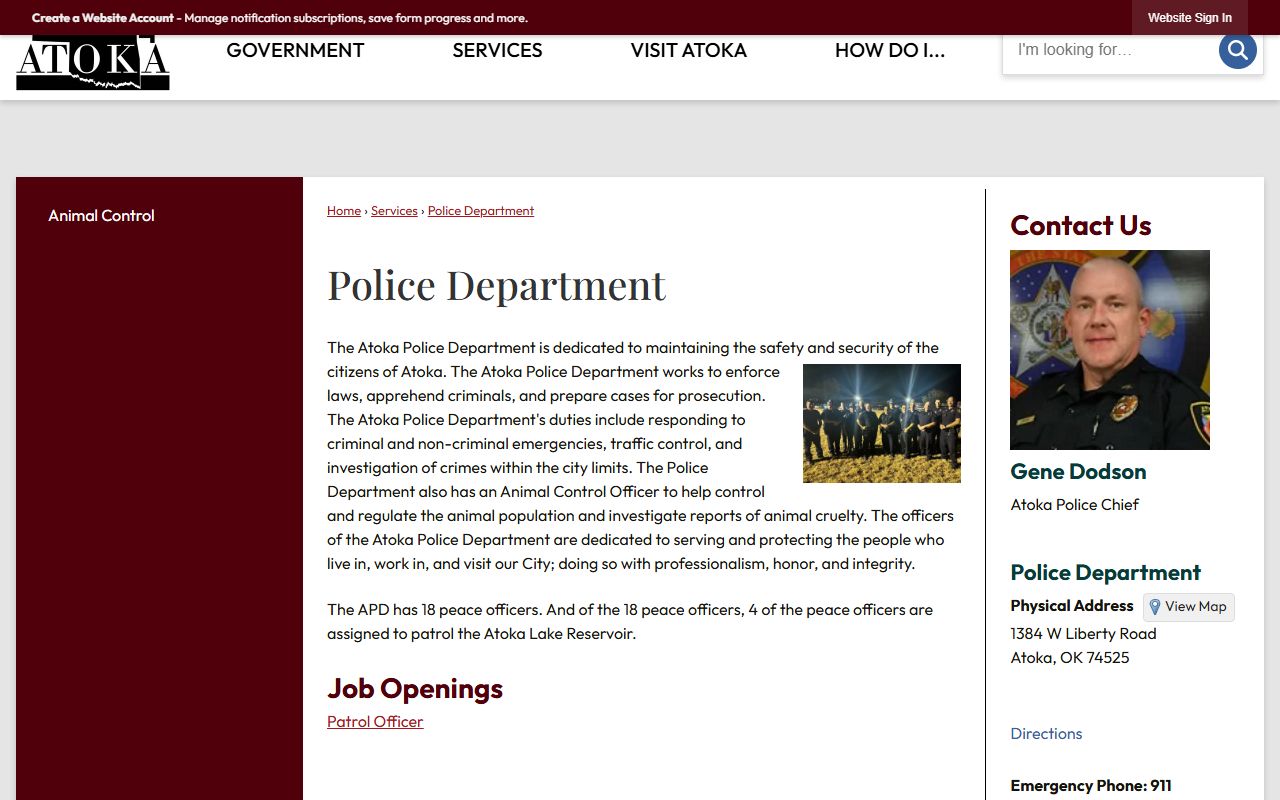
Chief Gene Dodson leads 18 officers from 1384 W Liberty Road, and four of them patrol the Atoka Lake Reservoir. An arrest by a city officer and an arrest by a county deputy can each lead to charges in the same District Court.
Who Files Charges in Atoka County
Charges in the county are filed by the district attorney, not the police. Atoka County sits in Oklahoma Prosecutorial District 19. District Attorney Tim Webster leads that district from an office at the Atoka County Courthouse. Officers send their reports and evidence to the DA. The DA reviews each case and decides whether the facts support a charge. If they do, the prosecutor files a charging document in the Atoka County District Court.
Once charges are filed, the Court Clerk takes over the paperwork. The clerk opens a case number, dockets each filing, and keeps the official file. The DA still represents the State of Oklahoma through the rest of the case. The two roles stay separate. The prosecutor decides and argues the charges, and the clerk records them. A defendant who cannot afford a lawyer may receive court-appointed counsel through the state indigent defense system that covers Atoka County.
Note: A police arrest does not guarantee a charge, since the district attorney can decline to file, amend the counts, or charge something different from the booking offense.
How Charges Get Filed After an Arrest
Every charge record starts with a charging document. That is the paper that formally accuses a person and opens the court case. After the arrest and booking, the prosecutor chooses which document to file. Oklahoma uses three main forms. The choice depends on how serious the offense is and how the case reaches the court.
| Complaint | Information | Indictment | |
|---|---|---|---|
| Filed By | Officer or Prosecutor | Prosecutor | Grand Jury |
| Common For | Misdemeanors | Many felonies | Serious felonies |
| Starts | The case | The case | The case |
In Oklahoma, most felony cases move forward on an Information after a preliminary hearing, where a judge decides whether enough evidence exists. A grand jury Indictment is less common and is saved for certain serious matters. A misdemeanor case can begin on a complaint or information filed straight by the prosecutor. Each one opens the case and sets the counts the defendant must answer.
Atoka County Charge Codes and Severity
Each charge ties to a specific law. The court record lists the count, the statute, and the offense text in plain words. Oklahoma sorts crimes by severity. A felony is the most serious class and can carry prison time. A misdemeanor is a lesser offense, usually punished by jail time under one year, a fine, or both. Some matters are simple infractions or citations. One arrest can produce several counts, so a single case may stack a felony with one or more misdemeanors.
Charge records also name the arresting agency and the officer. A public Atoka County District Court traffic case from 2025 shows the pattern. It lists a single count for operating a vehicle while the driver license was suspended. It names the arresting officer and the arresting agency, the Oklahoma Highway Patrol, along with the citation number and the offense location. Those fields tell a reader which department made the stop behind the charge.
The Oklahoma Sheriffs' Association page for Atoka County names the office behind many county arrests.
When sheriff's deputies make the arrest, their agency name appears in the charge record's arresting-agency field, just as the Highway Patrol does in a state trooper's case.
Charge Status and What It Means
Charges do not stay frozen. They change as a case moves through the court. A count can be amended, reduced, added, dropped, or dismissed. The docket records each shift so the public file shows where the charge stands. The terms below appear often in Oklahoma court records, and each one carries a clear legal meaning.
| Status | What It Means |
|---|---|
| Pending | The charge is filed and active, with no final outcome entered yet. |
| Amended or Reduced | The prosecutor changes the count, such as a felony dropping to a misdemeanor. |
| Added or Dropped | The state files a new count or removes one before the case ends. |
| Dismissed | The court ends the charge; with prejudice it cannot be refiled, without prejudice it may return. |
| Nolle Prosequi | Latin for "will not prosecute," meaning the district attorney chooses to drop the charge. |
Note: A dismissed or dropped charge can still appear in the public court file unless the record is later sealed or expunged under Oklahoma law.
Where Atoka County Charges Appear and How to Search
Filed charges show up in the state's online court systems. Two portals cover Atoka County District Court cases. The Oklahoma State Courts Network, or OSCN, and On Demand Court Records, or ODCR, both list county cases at no cost. Case numbers signal the charge level at a glance. A felony case carries a CF prefix, and a misdemeanor case carries a CM prefix. Traffic cases use TR. Reading the prefix tells a searcher the class of charge before opening the file.
- Open the OSCN docket search or the ODCR court search and pick Atoka County.
- Search by the defendant's name in Last, First form, or enter the case number if it is known.
- Open the case and read the count list, the statute text, and the named arresting agency.
- Check each count's code, severity level, and current status before relying on it.
Online dockets carry a warning. The pages state plainly that they are not the official record. For a certified copy or a file that is not online, the Court Clerk at the courthouse is the source. The clerk's office can confirm counts, bond, and court dates by phone at 580-889-3565.
Charges vs. Convictions
A charge is an accusation. A conviction is a finding of guilt. The gap between them matters for anyone reading an Atoka County charge record. A person can be charged and later cleared. The charge sits on the public docket while the case is open. To convict, the state must prove the case beyond a reasonable doubt, a far higher bar than the probable cause needed to file. Until that happens, the law treats the defendant as innocent.
| Charge | Conviction | |
|---|---|---|
| Stage | Accusation | Verdict or plea of guilt |
| Burden of Proof | Probable cause | Beyond a reasonable doubt |
| Meaning | The state alleges an offense | Guilt is established in law |
| Public Record | Yes | Yes |
How to Access Atoka County Arrest Records
Arrest records and booking detail follow a different path than court charges. The Atoka County Sheriff's Office runs the jail and holds the booking records. A current custody list shows who is held right now. For records that are public but not online, an Open Records Act request to the sheriff is the formal route. Oklahoma law opens basic law-enforcement records to the public under Title 51, Section 24A.8. The Sheriff's Office can also confirm a booking or warrant by phone at 580-889-2221.
The office itself changed hands recently. KXII reported that Kody Simpson won the Atoka County sheriff race in 2024, taking over from prior leadership.
A change in sheriff does not erase older arrest and booking records, which stay with the office and the courts. The charge filings tied to those arrests remain on the District Court docket no matter who holds the office.
Recent county news also touches the jail directly. KXII covered a settlement the Sheriff's Office reached over the death of an inmate.
Litigation like this shapes how the county handles custody and booking, yet the underlying arrest and charge records still flow through the same offices. For a full statewide criminal history, the Oklahoma State Bureau of Investigation is the official source rather than a single county docket. City charges follow their own track, since tickets and ordinance offenses written inside the city can stay with the Atoka Municipal Court at 580-889-3250.
Note: One person can appear across several systems at once, so the jail roster, the District Court dockets, and the city court may each hold a different piece.
Expungement of Atoka County Arrest and Charge Records
Some Atoka County arrest and charge records can be cleared from public view. Oklahoma calls this expungement. The main laws are Title 22, Sections 18 and 19, with Section 991c covering deferred sentences. An expungement normally starts as a petition in the District Court where the record sits. A judge then decides whether the person qualifies and whether the record should be sealed or destroyed.
- Sealed record
- Hidden from the public, while limited access can still be allowed for law enforcement and the courts.
- Expunged record
- Treated in law as if it never happened, with the public record removed and the arrest no longer attached.
The Oklahoma State Bureau of Investigation, or OSBI, handles the records side once an order is signed. OSBI says it cannot pre-approve eligibility before a petition is filed. Multiple arrests in the same county can go on one petition, but each county needs its own. After OSBI receives a certified copy of the order, court-record expungement takes about a month. Arrest-record expungement runs on a similar timeline once the order and any required fee arrive. The age of an arrest does not disqualify an eligible person, though the state can still object, and fingerprint cards are not destroyed even when the sealed arrest data is removed.