
Criminal Court Records in Atoka County
A criminal court record is the case file a court opens once a charge is filed. In Atoka County, that file lives with the Court Clerk, the office that records, files, and keeps the permanent records of District Court cases. The file is the whole story of one prosecution. It names the parties, lists each count, and logs every event in date order. Charges, the arraignment, pleas, motions, hearings, the verdict or plea, the disposition, and the sentence all sit in this one record. The charge itself is only the first page. For the charge as written at the start, the arrest and charge records go into more depth on how a count is framed.
The District Court is the trial court that hears these cases. It is a court of general jurisdiction, which means it handles both felony and misdemeanor matters for the county. A felony is a serious crime that can carry prison time, and its cases carry a CF prefix. A misdemeanor is a lesser crime with lighter penalties, and its cases carry a CM prefix. The District Attorney, not the court, decides what to file. Federal crimes are different. They are not Atoka County cases at all, and they go to the U.S. District Court for the Eastern District of Oklahoma instead.
Who Files Atoka County Criminal Charges
The District Attorney brings state charges. Atoka County sits in Oklahoma Prosecutorial District 19, led by District Attorney Tim Webster. The DA reviews the work police hand over and then decides whether to file a charge. Once filed, the case opens in District Court and the Court Clerk keeps the docket. The DA represents the State of Oklahoma from that point on. The District 19 Atoka office sits in the Atoka County Courthouse, Suite 202E, 200 E. Court Street, Atoka, OK 74525, and the phone is 580-889-6624. The District 19 page lists the office and its payment locations.
Defendants who cannot afford a lawyer get one through the Oklahoma Indigent Defense System. Atoka County falls under the OIDS Non-Capital Trial coverage that also serves Coal and Pontotoc counties. The contract attorney is Larry Balcerak, and his phone is 405-238-4460. The OIDS Atoka coverage page lists the contractor and the main office in Norman. Federal crimes follow a separate track. The U.S. Attorney for the Eastern District of Oklahoma prosecutes those, and that office is in no way part of the county court system.
The U.S. Attorney for the Eastern District of Oklahoma handles the federal side of serious crime in this region.
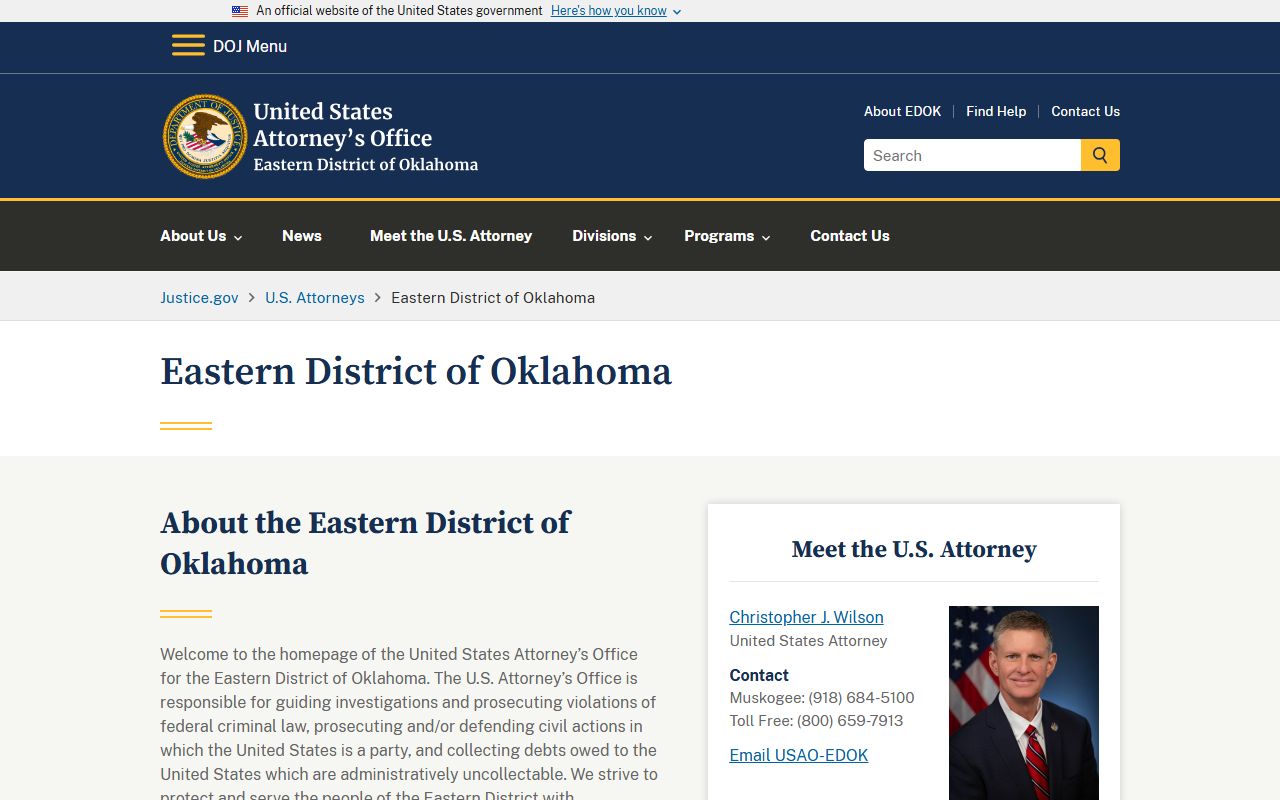
State charges from Atoka County, by contrast, stay with the District Attorney and the District Court, and the Court Clerk keeps that case file.
How to Search Atoka County Criminal Court Records
Two statewide portals carry Atoka County District Court cases. OSCN, the Oklahoma State Courts Network, is the first. ODCR, the On Demand Court Records site, is the second, and it also lists Atoka. Both let you search by a defendant's name or by a case number, and both show felony and misdemeanor dockets at no cost. A case number is the fastest way in. When you lack one, a full name in "Last, First" form works well.
- Open the OSCN docket portal or the ODCR search site and pick Atoka as the court.
- Search by the defendant's name in "Last, First" form, or paste an exact case number if you have it.
- Read the prefix on each result. CF marks a felony, CM marks a misdemeanor, and CR marks some criminal filings.
- Narrow by case type and filed-date range when a common name returns many hits.
- Open the case to read the docket, the counts, and the final disposition line.
- Request a certified copy from the Court Clerk when you need an official record for court or proof.
The online entries inform you, but they are not certified. OSCN warns that its data is not an official record and should be checked with the record keeper. For a broader look across every case type, the full court records overview covers civil, probate, and family files alongside criminal ones. To pull a statewide criminal history rather than a single county case, contact the Court Clerk for what is in the file or use the official state channels for a record check.
Stages of an Atoka County Criminal Case
A criminal case moves through set steps, and each step leaves a mark on the record. Reading the docket in order shows where a case stands. The flow below tracks a case from the first filing to the final sentence. Most entries on a criminal docket map to one of these stages.
Case flow: Charges Filed › Arraignment › Pretrial / Initial Appearance › Plea or Trial › Disposition › Sentencing
Here is what each main stage means and where it tends to appear in the file.
| Stage | What Happens |
|---|---|
| Charges Filed | The District Attorney files an information or complaint. The Court Clerk opens the case and assigns a CF or CM number. |
| Arraignment | The first formal court appearance. The judge reads the charge and takes a plea of guilty, not guilty, or no contest. |
| Pretrial / Initial Appearance | Early hearings set bond, schedule dates, and handle motions. A motion is a written request asking the judge to act. |
| Plea or Trial | The case ends in a plea deal or goes to trial, where a judge or jury weighs the evidence. |
| Disposition | The final outcome of each count, such as guilty, not guilty, or dismissed. |
| Sentencing | The judge orders the punishment after a conviction, such as a fine, jail, prison, or probation. |
What an Atoka County Criminal Court Record Shows
A criminal case file holds far more than a name and a charge. The docket lists the parties, the counts, every event, and the money owed. Public Atoka County dockets on OSCN follow a steady pattern, so once you learn the fields you can read any case. The table breaks down the core fields and what each one tells you.
| Field | What It Shows |
|---|---|
| Case Caption | The style of the case, such as State of Oklahoma versus the defendant, plus the case number and court. |
| Parties | The defendant, the District Attorney, the arresting officer and agency, and the attorney of record. |
| Counts / Charges | Each charge with its offense text, such as the statute cited or the act alleged. |
| Events | Hearing type, date, and time for each setting on the docket. |
| Docket Entries | A dated table of filings and orders, with code, description, count, party, and amount. |
| Bond and Warrants | Bond amount and conditions, plus any bench warrant entry for a missed appearance. |
| Financial Assessments | Fines, court costs, courthouse security, and revolving-fund fees charged to the case. |
| Disposition and Sentence | The outcome of each count and the punishment ordered after any conviction. |
Note: some Atoka County docket entries read "Document Available at Court Clerk's Office" rather than linking a file, so a courthouse visit may be needed for the full paper.
Reading Dispositions and Sentences
The disposition is the outcome of a charge, and the sentence is the punishment that follows a conviction. These words appear near the end of a docket, and they decide what the record really says. Some outcomes close a case for good. Others leave the door open. The terms below explain the most common entries in plain language.
- Plea
- The defendant's answer to a charge: guilty, not guilty, or nolo contendere, which means no contest.
- Conviction
- A finding or plea of guilt on a count. It is the legal basis for any sentence.
- Disposition
- The final result of a charge or the whole case, recorded count by count.
- Sentence
- The punishment a judge orders after a conviction, such as a fine, jail, prison, or supervision.
- Probation
- Supervised release served in place of or after jail, with rules the person must follow.
- Deferred Sentence
- A sentence delayed while the person meets conditions. Finishing them can lead to a dismissal.
- Dismissed With Prejudice
- The charge is dropped and cannot be refiled.
- Dismissed Without Prejudice
- The charge is dropped for now but may be refiled later.
Atoka County Charges Versus Convictions
Being charged is not the same as being convicted. A charge is an accusation. A conviction is a finding of guilt. An Atoka County criminal court record can show charges that were dropped, dismissed, or ended in an acquittal, which is a not-guilty verdict. Reading a file as if every charge equals guilt gets the story wrong. The split matters most when the record drives a hiring or housing choice.
| Charge | Conviction | |
|---|---|---|
| Stage | Accusation at filing | Verdict or guilty plea |
| Who Decides | District Attorney | Judge or jury |
| Burden of Proof | Probable cause | Beyond a reasonable doubt |
| Can It Be Dropped | Yes, by dismissal or amendment | Only on appeal or post-conviction relief |
| Public Record | Yes | Yes |
State and Federal Criminal Cases
Not every crime in Atoka County is a county case. The District Court hears charges the District Attorney files under state law. Federal charges go somewhere else entirely. Atoka County is one of 26 counties in the U.S. District Court for the Eastern District of Oklahoma, a region the Department of Justice describes as entirely Indian country. A drug, firearm, or major federal case from the county is filed and heard there, not at the courthouse on East Court Street.
Federal records use their own systems. The Eastern District CM/ECF system is the court's electronic case file and filing tool.
That system holds the filings, but public viewing of federal dockets runs through a separate paid account. To open one or to find the right court code, start at the lookup page below.
The PACER court lookup for the Oklahoma Eastern District shows the CM/ECF help-desk line and account details.
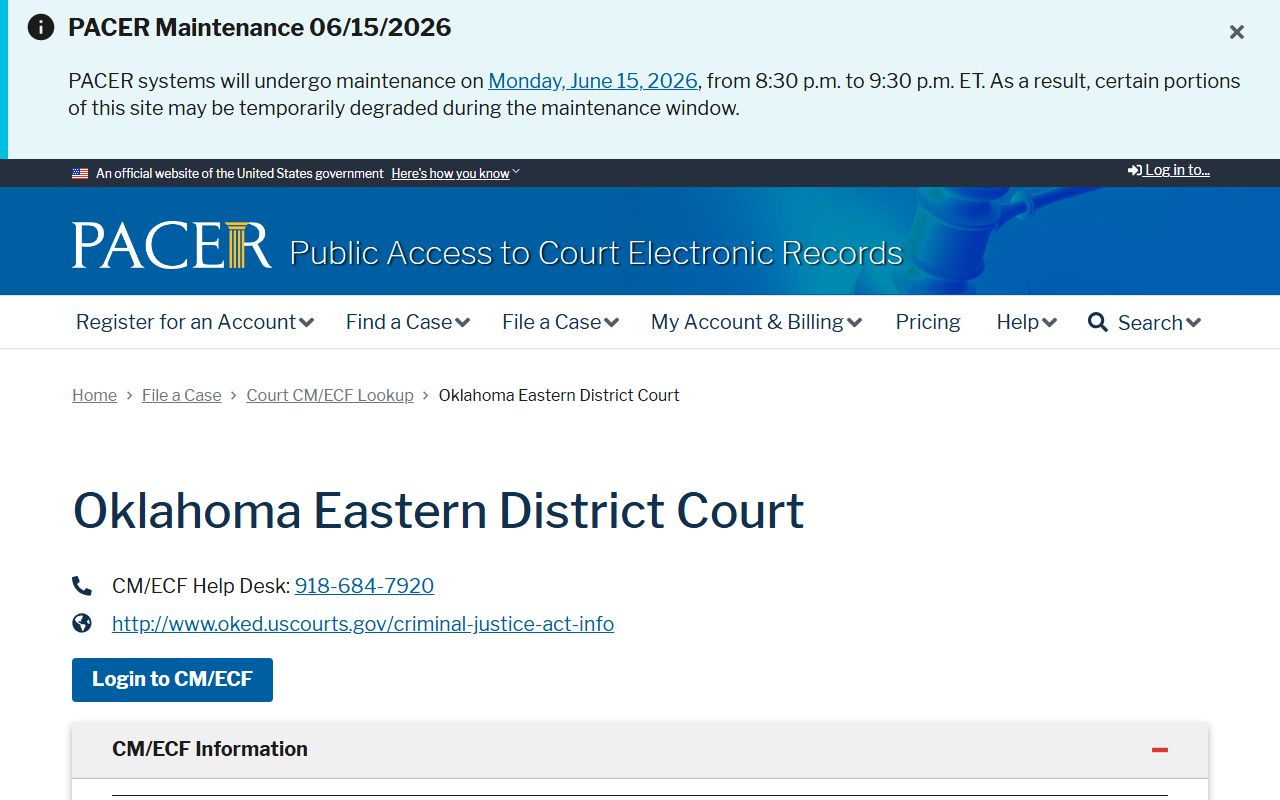
So a county felony shows up on OSCN or ODCR, while a federal case from the same county shows up only on PACER. Knowing which court holds the case saves a wasted search.
Sealed Versus Expunged Records
Some Atoka County criminal records are hidden from public view. Sealing and expungement are the two ways that happens, and they are not the same. A sealed record still exists but is closed to the public. An expunged record is treated as if it never existed. Oklahoma sets the rules under Title 22, Sections 18 and 19 for most cases and Section 991c for a finished deferred sentence. The Oklahoma State Bureau of Investigation handles the records side of the process.
The OSBI expungement page explains who may qualify and how the process runs.
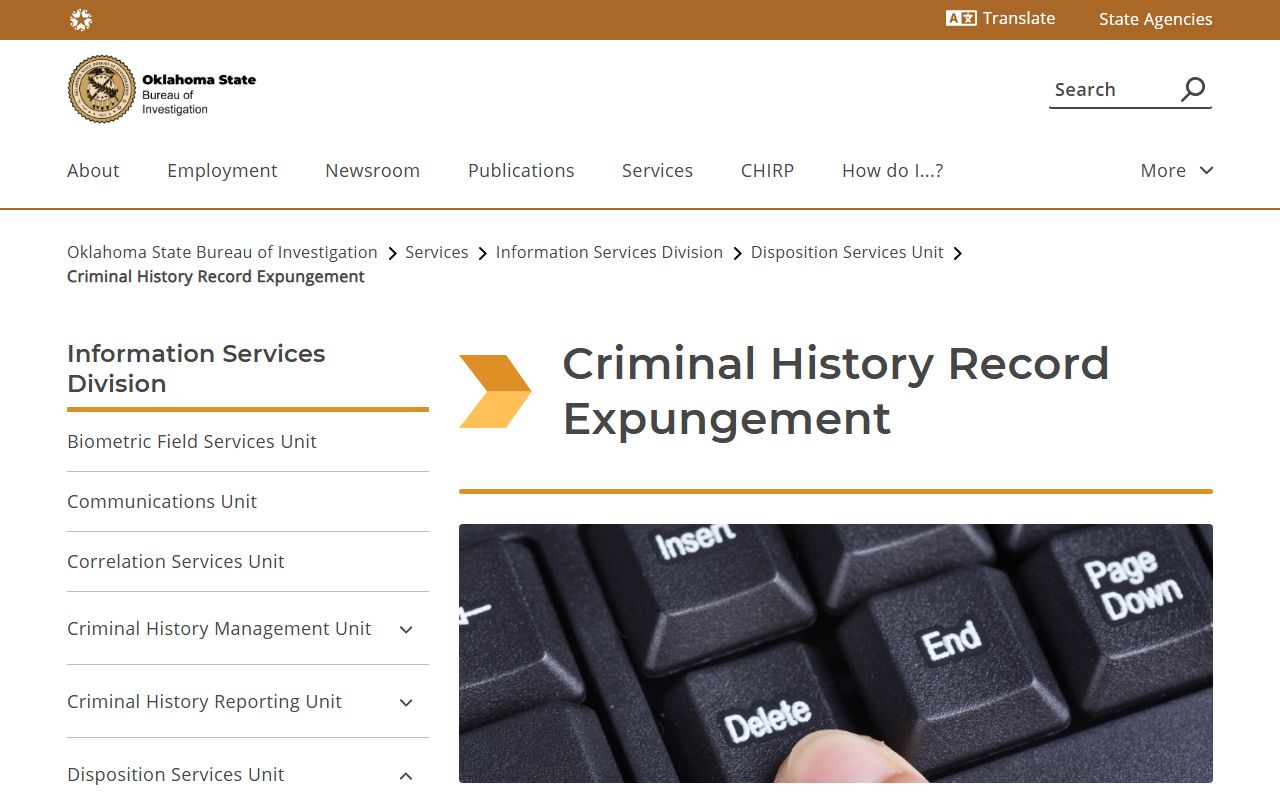
An expungement starts as a petition in the District Court where the record sits. A separate petition is needed for each county that holds records, though several arrests in one county can share a petition. OSBI says court-record expungement takes about one month after it receives the certified order. The state can object even when a person qualifies, and fingerprint cards are not destroyed. The table sorts out the two paths.
| Sealed | Expunged | |
|---|---|---|
| Visibility | Hidden from the public | Treated as though it never existed |
| Law Enforcement | Limited access remains | Very limited access |
| Where to File | District Court for the case | District Court where the record exists |
| Eligibility | Set by 22 O.S. Section 19 order | Set by 22 O.S. Section 18 and Section 991c |
Public Access to Atoka County Criminal Records
Most criminal court files in Atoka County are open to the public. The Oklahoma Open Records Act sets that baseline, and court records carry their own access rules on top of it. A record stays open unless a statute makes it confidential or a judge seals it. You can view dockets online for free, and you can ask the Court Clerk to inspect or copy a file during business hours. Certified copies may carry a fee that was not published in the official Atoka sources located, so confirm the cost with the Court Clerk.
Key Statutes:
51 O.S. Section 24A.5 - public records are open to inspection unless a statute makes them confidential.
51 O.S. Section 24A.8 - sets public access to basic law-enforcement records such as arrest and booking data.
Background Check Considerations
A casual docket search is not the same as a formal background check. Reading a free OSCN or ODCR docket tells you about one case. A regulated background report pulls records for hiring, housing, or credit, and federal law governs how those reports are built and used. For a decision with legal weight, an employer or landlord should rely on a screening firm that follows the Fair Credit Reporting Act. For personal curiosity or to track a known case, the public dockets work well.
Important: This site is not a consumer reporting agency under the Fair Credit Reporting Act, and its information cannot be used for credit, employment, tenant, or insurance decisions.
Restricted Criminal Court Records in Atoka County
Not every criminal file is open. Juvenile and youthful-offender matters are often restricted, so do not expect full online access to them. Sealed and expunged cases drop off the public OSCN and ODCR view by court order. Some search warrants stay sealed while active and open only later. Personal details such as Social Security numbers, financial-account numbers, minor names, and protected addresses may be redacted, which means masked from view.
When a record is restricted, the path forward runs through the court. Ask the Court Clerk whether a file exists and what access a court order would require. A bench warrant tied to a District Court case still shows as a docket entry, even when the wider file is limited. A criminal court file marked restricted is not gone, but reaching it takes the right authority and the right office.